Choledochal Cyst
Understanding Congenital Bile Duct Cysts and Their Treatment
A choledochal cyst is a rare congenital enlargement of the bile ducts. Although some patients are diagnosed during childhood, many are not identified until adulthood. Modern surgery aims to remove the abnormal bile duct completely, preventing future complications and reducing the long-term risk of bile duct cancer.
Choledochal cysts are not simply "cysts." They are congenital abnormalities of the bile ducts that carry a lifelong risk of complications, including bile duct cancer. Complete surgical removal is the recommended treatment in most patients.
Overview
What Is a Choledochal Cyst?
A choledochal cyst is an abnormal widening (dilatation) of the bile ducts that is present from birth.
The bile ducts carry bile from the liver to the small intestine.
Although the condition is congenital, symptoms may not appear until adolescence or adulthood.
Unlike simple liver cysts, choledochal cysts involve the bile ducts and usually require surgical treatment.
Causes
Why Do Choledochal Cysts Develop?
The exact cause is not always known. The most widely accepted explanation is an abnormal junction between the pancreatic duct and bile duct, allowing pancreatic enzymes to reflux into the bile duct and weaken its wall over time.
Normal Anatomy
The pancreatic duct and bile duct join at a common point outside the duodenal wall, preventing reflux of pancreatic enzymes.
Abnormal Pancreaticobiliary Junction
An abnormal junction allows pancreatic enzymes to reflux into the bile duct, causing chronic inflammation and progressive weakening of the duct wall.
Classification
Types of Choledochal Cysts — Todani Classification
Treatment depends on the type of cyst.
Type I
Most common. Dilatation of the common bile duct.
Type II
Diverticulum (outpouching) of the bile duct.
Type III (Choledochocele)
Cyst located within the wall of the duodenum.
Type IV
Multiple cysts involving intrahepatic and extrahepatic bile ducts.
Type V (Caroli Disease)
Cysts involving only the intrahepatic bile ducts.
Symptoms
Symptoms of a Choledochal Cyst
Some adults are diagnosed incidentally during ultrasound or CT scans performed for unrelated reasons.
Complications
Possible Complications
Complete surgical excision prevents these serious complications.
Cholangitis
Repeated infection of the bile ducts.
Pancreatitis
Inflammation of the pancreas due to abnormal pancreaticobiliary junction.
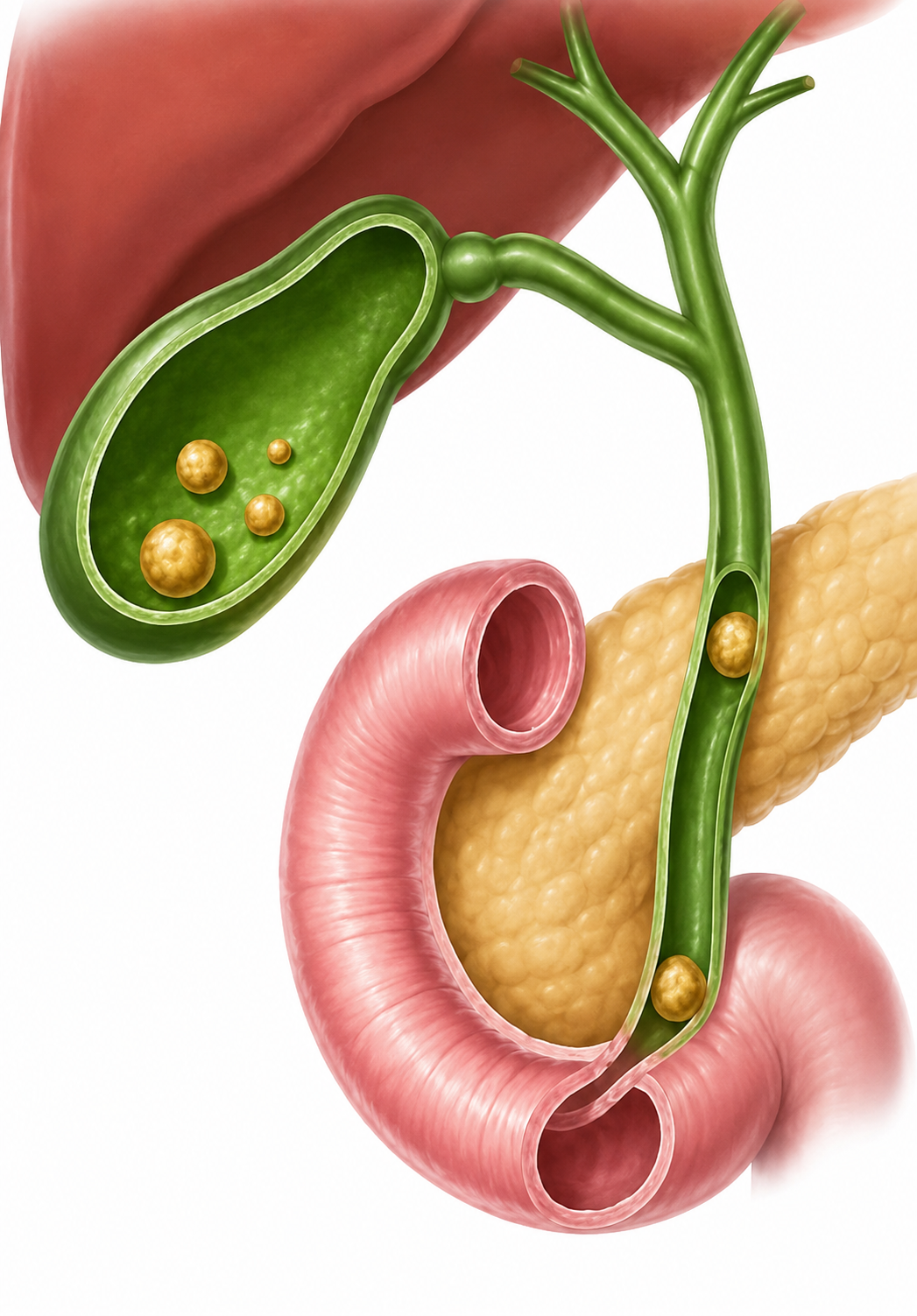
Bile Duct Stones
Stones may form inside the abnormal bile duct.
Liver Damage
Long-standing obstruction may lead to liver fibrosis or cirrhosis.
Bile Duct Cancer (Cholangiocarcinoma)
Patients with untreated choledochal cysts have a significantly increased lifetime risk of developing bile duct cancer. This is one of the main reasons complete surgical removal is recommended.
Diagnosis
How Is a Choledochal Cyst Diagnosed?
MRCP is the preferred imaging study because it provides detailed images of the bile ducts without the need for invasive procedures.
Symptoms
Assessment of symptoms and medical history
Blood Tests
Liver function tests, pancreatic enzymes, inflammatory markers
Ultrasound
Initial detection of bile duct dilatation
MRCP
Magnetic resonance cholangiopancreatography — the preferred imaging study
CT Scan
Assessment of cyst anatomy and relationship to adjacent structures
Review by Hepatobiliary Surgeon
Specialist assessment to determine cyst type and treatment plan
Treatment Plan
Personalised surgical plan
Treatment
Treatment Options
Observation
Rarely appropriate except in selected situations after specialist assessment.
Endoscopic Treatment
Limited role. Used mainly for Type III cysts (choledochoceles) in selected patients.
Complete Surgical Excision
The standard treatment. Removal of the entire extrahepatic bile duct.
Roux-en-Y Hepaticojejunostomy
After removing the abnormal bile duct, bile flow is restored by connecting the healthy bile ducts directly to the small intestine.
Surgical Indications
When Is Surgery Recommended?
Surgery is recommended for nearly all patients because it:
Surgery is usually advised even if symptoms are mild.
The Operation
The Operation
Complete removal of the cyst is preferred over drainage procedures, which are no longer recommended because they leave abnormal tissue behind.
Abnormal bile duct
Identification and careful dissection of the cyst
Complete removal
Excision of the entire extrahepatic bile duct
Preservation of healthy bile ducts
Preservation of normal intrahepatic bile ducts
Roux-en-Y hepaticojejunostomy
Connecting healthy bile ducts to the small intestine to restore bile flow
Why Complete Excision?
Why Complete Excision Is Important
Complete excision has become the accepted standard of care worldwide and reinforces the importance of management by an experienced hepatobiliary surgeon.
Older Drainage Procedures (Historical)
Modern Standard Treatment
Recovery
Recovery After Surgery
Regular follow-up helps monitor the reconstruction and liver function.
Diagnosis
Confirmation of cyst type and preoperative assessment
Preoperative Assessment
Blood tests, cardiac assessment, anaesthetic review
Operation
Complete excision and reconstruction
Hospital Recovery
Post-operative monitoring, typically 3–7 days
Home Recovery
Gradual return to activity
Long-Term Follow-up
Regular monitoring of liver function and biliary health
Understanding the Condition
Understanding Choledochal Cysts
Is a choledochal cyst just a simple cyst?
No. It is a congenital abnormality of the bile ducts and is different from a simple liver cyst.
Can a choledochal cyst become cancer?
Yes. If left untreated, the lifetime risk of developing bile duct cancer is significantly higher than in the general population. Complete surgical removal greatly reduces this risk but does not eliminate it completely, so long-term follow-up is still important.
Can adults be diagnosed for the first time?
Yes. Many patients remain symptom-free during childhood and are diagnosed only in adulthood.
Is surgery always necessary?
Complete surgical excision is recommended for most patients because it prevents recurrent infections, pancreatitis, stone formation, and substantially reduces the risk of future malignancy.
Can minimally invasive surgery be performed?
In selected patients, laparoscopic or robotic surgery may be appropriate, depending on the type of cyst, its anatomy, and the experience of the surgical team.
FAQ
Frequently Asked Questions
Why Choose Us
Why Choose Prof. Walid Elmoghazy?
Senior Consultant in HPB Surgery
Academic and clinical expertise in liver, pancreas, and biliary surgery
Clinical Lead of Liver Surgery & Transplantation
Leadership in the most complex liver resection and transplantation procedures
International Fellowship Training
Specialised training in Japan, UK, Canada, and France
1,000+ Major HPB Procedures
Extensive experience in liver, pancreas, and biliary surgery
Complex Biliary Reconstruction
Expertise in complex biliary reconstruction and choledochal cyst surgery
Laparoscopic & Open Surgery
Advanced laparoscopic and open hepatobiliary surgery
Multidisciplinary Approach
Multidisciplinary management of congenital biliary disorders
Second Opinion
Request a Second Opinion
If you have been diagnosed with a choledochal cyst or advised to undergo surgery, an expert second opinion can help confirm the diagnosis and identify the most appropriate treatment.
Have You Been Diagnosed with a Choledochal Cyst?
Complete surgical removal provides the best long-term protection against complications and significantly reduces the risk of bile duct cancer. If you have questions about your diagnosis or treatment options, schedule a consultation or request a second opinion.
 Bile Duct Stones
 Bile Duct Injury
 Gallstone Disease
 Liver Cancer
 Pancreatic Cancer