
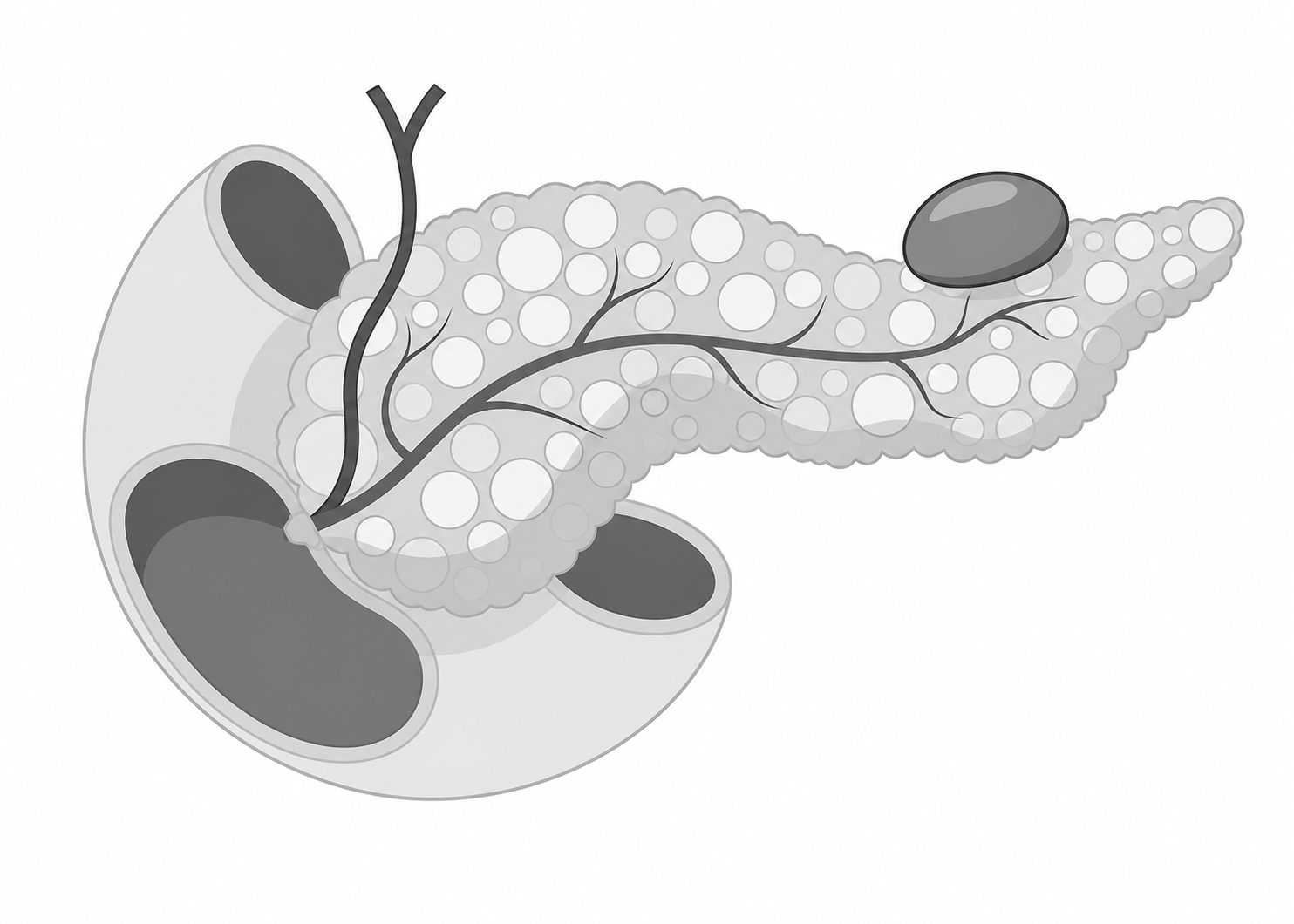
Pancreatic Cysts
Understanding Pancreatic Cysts and Their Treatment
Pancreatic cysts are increasingly discovered during CT and MRI scans performed for unrelated reasons. Most pancreatic cysts are benign and never require surgery, but some have the potential to develop into cancer over time. Careful evaluation helps determine which cysts can be safely monitored and which require treatment.
Most pancreatic cysts are not cancer, and many can be monitored safely without surgery. However, some cysts have the potential to become cancerous and require careful evaluation by an experienced pancreatic surgeon.
Overview
What Are Pancreatic Cysts?
A pancreatic cyst is a fluid-filled sac that develops within or on the pancreas.
Some cysts are harmless and remain stable for many years.
Others are considered precancerous lesions, meaning they have the potential to become cancer if left untreated.
Most pancreatic cysts are discovered incidentally during imaging for other medical conditions.
Classification
Types of Pancreatic Cysts
Serous Cystadenoma (SCA)
- Benign
- Very low risk of cancer
- Often requires observation only
Mucinous Cystic Neoplasm (MCN)
- Usually occurs in women
- Considered precancerous
- Surgery may be recommended depending on size and features
Main Duct IPMN
- Produces mucus
- Involves the main pancreatic duct
- Often requires surgery
Branch Duct IPMN
- Produces mucus
- Involves branch ducts
- Some can be monitored with regular imaging
Pseudocyst
- Usually develops after pancreatitis
- Not a true cyst
- Often resolves spontaneously or is treated if symptomatic
Solid Pseudopapillary Neoplasm (SPN)
- Rare tumour
- Usually occurs in young women
- Surgical removal is recommended
Cystic Neuroendocrine Tumour
- Rare but important to recognise
- Requires specialist evaluation
Symptoms
Symptoms of Pancreatic Cysts
Many pancreatic cysts produce no symptoms.
Many pancreatic cysts are discovered accidentally during CT or MRI scans performed for unrelated conditions.
Diagnosis
How Are Pancreatic Cysts Diagnosed?
MRI and endoscopic ultrasound are the most important investigations for characterising pancreatic cysts.
Incidental CT Scan
Cyst discovered during imaging for another medical condition
MRI / MRCP
Preferred imaging to characterise the cyst and its relationship to the pancreatic ducts
Endoscopic Ultrasound (EUS)
Detailed examination of the cyst, its walls, and any solid nodules
Fine Needle Aspiration (Selected Patients)
Cyst fluid analysis to determine type and risk level
Multidisciplinary Review
Joint assessment by pancreatic surgeon, gastroenterologist, and radiologist
Individualised Management Plan
Personalised decision: surveillance or surgery
Surgical Indications
Which Pancreatic Cysts Need Surgery?
Not every pancreatic cyst requires surgery. Features suggesting surgery may be appropriate include:
The decision for surgery is individualised based on cyst type, size, features, and the patient's overall condition.
Decision Guide
Which Pancreatic Cysts Require Surgery?
Treatment decisions are individualised and based on established international guidelines, not cyst size alone.
Usually Observation
- Serous cystadenoma
- Small branch duct IPMN without concerning features
- Stable pancreatic pseudocyst
Individualised Assessment
- Medium-sized mucinous cysts
- Branch duct IPMN with possible "worrisome features"
- Indeterminate cysts
Surgery Often Recommended
- Main duct IPMN
- Mucinous cystic neoplasm with high-risk features
- Solid pseudopapillary neoplasm
- Cysts with mural nodules, obstructive jaundice, or suspicious cytology
Treatment
Treatment Options
Observation
Most pancreatic cysts can be monitored safely with regular MRI or CT scans.
Endoscopic Drainage
Used mainly for pancreatic pseudocysts.
Distal Pancreatectomy
Removal of the body and tail of the pancreas. Commonly performed for MCN and cysts in the left side.
Whipple Procedure
Recommended for selected cysts located in the head of the pancreas.
Enucleation
Removal of selected small cystic tumours while preserving the pancreas.
Total Pancreatectomy
Rarely required. Reserved for selected extensive disease.
Surveillance
Monitoring Pancreatic Cysts
Follow-up depends on:
Diagnosis
Confirmation of cyst type and characteristics
MRI
Baseline imaging to characterise the cyst
6–12 Month Follow-up
Repeat imaging to detect any changes
Repeat Imaging
Monitoring size and features over time
Long-Term Surveillance
Ongoing follow-up programme per international guidelines
Recovery
Recovery After Pancreatic Surgery
Recovery depends on the type of pancreatic operation performed.
Diagnosis
Confirmation of cyst type and treatment plan
Preoperative Assessment
Surgical fitness evaluation and operative planning
Operation
Cyst removal based on type and location
Hospital Recovery
Post-operative monitoring, typically 5–10 days
Home Recovery
Gradual return to activity over several weeks
Long-Term Follow-up
Regular monitoring of pancreatic function and any recurrence
Understanding the Condition
Understanding Pancreatic Cysts
Does every pancreatic cyst mean cancer?
No. Most pancreatic cysts are benign, and many never require surgery.
Can a pancreatic cyst become cancer?
Some types, such as MCNs and certain IPMNs, have the potential to become cancerous over time. Careful assessment helps determine the level of risk.
Why is MRI often recommended instead of repeated CT scans?
MRI provides excellent detail of the pancreatic ducts and cyst while avoiding repeated radiation exposure.
Will I need surgery immediately?
Not necessarily. Many patients are safely managed with scheduled imaging surveillance according to international guidelines.
What is an endoscopic ultrasound (EUS)?
EUS is a minimally invasive procedure that allows detailed examination of the cyst and, when appropriate, collection of fluid samples for further analysis.
FAQ
Frequently Asked Questions
Why Choose Us
Why Choose Prof. Walid Elmoghazy?
Senior Consultant in HPB Surgery
Academic and clinical expertise in liver, pancreas, and biliary surgery
Clinical Lead of Liver Surgery & Transplantation
Leadership in the most complex liver resection and transplantation procedures
International Fellowship Training
Specialised training in Japan, UK, Canada, and France
1,000+ Major HPB Procedures
Extensive experience in liver, pancreas, and biliary surgery
Expertise in Pancreatic Cysts, IPMN & MCN
Specialist in the evaluation and treatment of complex pancreatic cysts
Advanced Laparoscopic & Robotic Pancreatic Surgery
Minimally invasive pancreatic surgery expertise
Multidisciplinary Pancreatic Programme
Integrated specialist team for pancreatic conditions
Second Opinion
Request a Second Opinion
If you have been diagnosed with a pancreatic cyst or advised to undergo pancreatic surgery, an expert second opinion can help determine whether monitoring or surgery is the most appropriate treatment.
Have You Been Diagnosed with a Pancreatic Cyst?
Most pancreatic cysts can be safely monitored, while others benefit from timely surgical treatment. Accurate diagnosis is the key to choosing the safest and most appropriate management plan.
 Pancreatic Cancer
 Liver Metastases
 Bile Duct Injury
 Choledochal Cyst
 Liver Cysts